HR: Friend or Foe
This piece examines the fundamental tension in modern HR: employees overwhelmingly distrust HR departments, viewing them as management's enforcers rather than employee advocates. 54% of employees trust AI more than HR professionals, and research indicating only 7% believe HR looks out for workers, this blog explores why this perception exists and whether it's justified. Drawing on CIPD research and workplace data, it explores why employees increasingly view HR with suspicion, the structural problems that create this distrust, and what this means for workers navigating disciplinary processes or workplace disputes.
HR: Friend or Foe? IMO on the Trust Problem
Let's address the elephant in every office: nobody facing a disciplinary investigation calls HR thinking, "Finally, someone who's on my side."
I've spent years representing employees in workplace disputes, and I can count on one hand the number of times someone has told me they trust their HR department to protect their interests. The rest? They view HR somewhere between sceptical and openly hostile. And here's the uncomfortable truth: they're not entirely wrong.
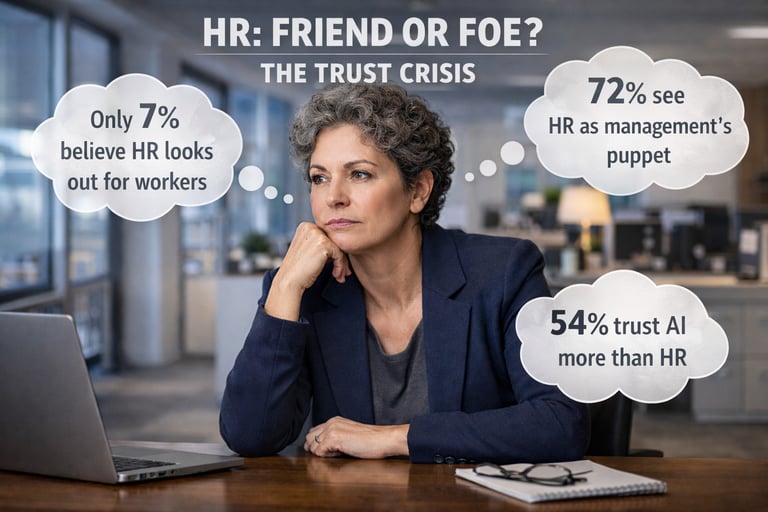
Recent research paints a damning picture. A 2024 survey found that 54% of employees trust AI more than HR professionals. Think about that for a moment. Workers would rather take advice from an algorithm than the human beings employed specifically to manage employee relations. Another study revealed that fewer than 7% of workers believe HR looks out for employees, while 72% consider HR to be management's puppet.
These aren't small perception problems. This is a fundamental crisis of trust.
The Structural Problem: Who Pays the Bills?
The issue with modern HR isn't that HR professionals are malicious. Most aren't. Many genuinely care about employee wellbeing and want to create fair, healthy workplaces. The problem is structural: HR is paid by, reports to, and is evaluated by senior management.
When push comes to shove—and it always does in disciplinary matters—HR's loyalty is to the organisation, not the individual employee. This isn't a character flaw; it's an institutional reality. Employees increasingly perceive HR as prioritising the company's interests at the expense of their own, and organisational restructuring and economic pressures have only intensified this perception.
It's understandable that HR has its employer's best interests at heart given that they work for them. HR professionals might argue they're "neutral facilitators" ensuring fairness and compliance, but neutrality is a myth when your performance review and continued employment depend on keeping management happy.
The Disciplinary Process: Where the Mask Slips
Nowhere is HR's alignment with management more apparent than in disciplinary processes. ACAS guidance is clear that employers should follow a fair procedure, with HR facilitating investigations and hearings. In theory, HR ensures procedural fairness. In practice? They're often the architects of the case against the employee.
I've seen it repeatedly: HR conducts the investigation, drafts the allegations, advises the hearing manager, prepares the dismissal letter, and then—with a straight face—claims they're just "facilitating a fair process." The employee sits across the table knowing full well that everyone in that room is on the employer's payroll.
The ACAS Code mandates that employees have the right to be accompanied at disciplinary hearings by a colleague or trade union representative, specifically because the power imbalance is so stark. The very existence of this right acknowledges that the employee needs someone in their corner who isn't institutionally aligned with management.
And let's be honest about what happens when an employee raises a grievance against their manager. HR is supposed to investigate impartially, but how impartial can you be when the person you're investigating signs off on your budget and promotions? The system is rigged from the start.
The "Employee Wellbeing" Paradox
Modern HR loves talking about employee wellbeing, mental health support, and creating "psychologically safe" workplaces. These initiatives aren't necessarily insincere, but there's a massive gap between HR rhetoric and reality.
Research from the Institute for Employment Studies noted that employees see through what's been called the "HR policy:practice, say:do gap" and no longer trust their employers and HR. One expert memorably described the superficial engagement surveys and ineffective wellness programmes as "tea and pilates" approaches that do nothing to address escalating workplace ill health.
Here's the paradox: HR departments champion wellbeing initiatives while simultaneously managing the disciplinary processes that are among the biggest sources of workplace stress. They'll send you an email about mental health awareness week, then issue you with a final written warning that keeps you awake at night for months.
When workers are struggling—genuinely burnt out, experiencing mental health crises, or dealing with serious personal issues—HR's response is often to direct them to an Employee Assistance Programme while simultaneously documenting their absence or performance issues as a prelude to disciplinary action.
The data backs this up. Studies show that restricting access to training and paid overtime erodes employee trust, yet HR departments routinely implement these cost-cutting measures while claiming to prioritise employee development and wellbeing.
The Trust Deficit: By the Numbers
The scale of employee distrust in HR is staggering. Only 7% of workers believe HR looks out for them, while 72% consider HR to be management's puppet. Perhaps most striking, 54% trust AI more than HR professionals.
These aren't marginal concerns. This is the majority of the workforce fundamentally doubting that HR serves their interests.
Research also shows that 77% of UK employees face a productivity crisis caused by dysfunctional HR tools, suggesting that even the basic administrative functions of HR are failing workers. The trust problem isn't just about bias—it's about competence, accessibility, and whether HR actually makes employees' working lives better or worse.
When HR Actually Helps (And When It Doesn't)
To be fair, there are situations where HR does protect employees:
Compliance and legal requirements: HR ensures statutory obligations are met—minimum wage, holiday pay, discrimination law. When management wants to do something blatantly illegal, HR often pushes back. But this isn't about employee advocacy; it's about protecting the organisation from legal liability.
Policy consistency: HR prevents managers from making arbitrary decisions that expose the company to tribunal claims. If two employees commit the same misconduct, HR ensures they face similar consequences. This isn't fairness for fairness's sake—it's avoiding discrimination claims.
Administrative efficiency: HR manages payroll, benefits, and onboarding. These functions are genuinely helpful to employees, but they're also basic operational necessities.
What HR doesn't do—and structurally can't do—is advocate for individual employees when their interests conflict with the organisation's. When an employee faces dismissal, needs flexibility their manager won't grant, or wants to challenge a decision that management supports, HR isn't your ally. They can't be.
The AI Alternative: Why Workers Trust Algorithms
The finding that workers trust AI more than HR initially sounds absurd, but it makes sense when you understand what employees are actually saying. They're not claiming AI is more caring or empathetic. They're saying AI is potentially less biased.
When asked about fairness, 65% of respondents were confident AI-based tools would be used fairly, while only 27% better trusted HR. Employees know that managers have biases—recency bias, confirmation bias, personal likes and dislikes. HR inherits and often reinforces these biases because HR serves management.
AI, for all its flaws, doesn't care if you're friends with the CEO or if you challenged your manager in last week's meeting. It won't dismiss your grievance because investigating would be politically awkward. The algorithm doesn't have a career to protect.
This isn't an endorsement of AI replacing human judgment in workplace decisions—that brings its own serious problems. But the fact that workers see algorithms as more trustworthy than HR professionals tells you everything about how HR is perceived.
What Employees Actually Need
From an employee advocate's perspective, here's what workers need that HR structurally cannot provide:
Independent Representation: When facing disciplinary action, employees need someone whose only job is defending them. Not "facilitating fairness." Not "ensuring compliance." Not "protecting the organisation." Someone whose sole focus is their interests. That's what trade union reps and independent advocates do.
Confidential Advice: Employees need to discuss workplace problems with someone who won't feed that information back to management. Every conversation with HR is potentially discoverable, documented, and useable against you later. There's no privilege, no confidentiality.
Power Balancing: The employment relationship is inherently unequal. The employer has money, lawyers, HR departments, and institutional knowledge. The employee has their right to be accompanied at hearings. That statutory right exists precisely because Parliament recognised that employees are structurally disadvantaged.
Challenge and Scrutiny: Someone needs to hold employers accountable when they cut corners, violate procedures, or treat employees unfairly. HR won't do this because HR works for the employer. External advocates, unions, and (increasingly) the Fair Work Agency exist to provide that challenge.
The Reality for HR Professionals
I don't envy HR professionals. They're caught in an impossible position. Research shows that employees often perceive HR as prioritising company interests at the expense of their own, but HR's remit includes supporting working conditions, equal opportunities and employee welfare, and legal obligations mean they must remain impartial.
This creates cognitive dissonance. HR professionals are trained in employee relations, understand ACAS guidance on fair procedures, and generally believe in treating people well. But they're measured and rewarded based on organisational outcomes: reducing tribunal claims, managing headcount, controlling costs, maintaining productivity.
When these objectives conflict with individual employee interests—and they frequently do—there's only one winner. The employee loses, and HR implements the decision while maintaining they followed a "fair process."
So, Friend or Foe?
Neither. HR is institutionally incapable of being your friend, but calling them your "foe" oversimplifies. HR is your employer's function, serving your employer's interests, within legal and procedural constraints. Sometimes those interests align with yours. Often they don't.
The mistake employees make is expecting HR to advocate for them. HR's job is to manage you as a resource, mitigate legal risk to the organisation, and ensure compliance with employment law. These functions occasionally benefit employees, but that's a side effect, not the primary purpose.
As one HR professional acknowledged, HR's responsibility is to protect the collective organisation from the CEO to managers and individual employees. But when there's a conflict between protecting the CEO and protecting you, which way do you think that scales?
The Way Forward: Why Independent Advocacy Matters
The breakdown in trust between employees and HR isn't a communication problem that can be fixed with better engagement surveys or wellbeing initiatives. It's a structural reality that requires structural solutions.
This is why independent workplace advocacy—whether through trade unions, certified representatives like us at Zhan Associates, or employment solicitors—is essential. You need someone in your corner whose success depends on defending your interests, not managing you as an organisational resource.
ACAS recognises this, which is why employees have a statutory right to be accompanied at disciplinary and grievance hearings. That right doesn't exist because the process is already fair. It exists because Parliament understood that employees need someone who isn't on the employer's payroll sitting next to them.
The introduction of the Fair Work Agency in April 2026 acknowledges the same fundamental truth: employer self-regulation doesn't work. Workers need external bodies with enforcement powers to hold employers accountable. HR can't do this because HR is part of the employer.
Final Thoughts
If you're an employee reading this, here's my advice: be polite and professional with HR, but don't mistake courtesy for alliance. When facing a workplace dispute—particularly disciplinary action—get independent advice immediately. Don't rely on HR to protect your interests, because that's not their job.
If you're an HR professional reading this and feeling defensive, ask yourself honestly: when your CEO wants to dismiss someone and you know the process is shaky, do you stand your ground and refuse to facilitate it? Or do you find a way to make it "defensible enough" to proceed? Your answer tells you whether you're truly independent or whether you're exactly what employees think you are.
Trust in the workplace matters. Research shows that high-trust organisations outperform low-trust competitors. But trust can't be built on institutional conflicts of interest and euphemistic job titles. HR is "Human Resources," not "Human Advocacy." That's not a criticism; it's just truth in advertising.
Workers deserve someone in their corner who isn't conflicted, isn't managing them, and isn't worried about next quarter's headcount targets. That's not HR. That's why independent advocacy exists.
And until organisations recognise this structural reality, the trust deficit will remain. No amount of mental health awareness emails will bridge that gap.
---
About this article: This blog reflects the views of Zhan Associates as workplace advocates. We are not solicitors and this is not legal advice. For specific legal guidance, consult a qualified employment solicitor. If you're facing a disciplinary hearing and need independent advocacy support, [contact us](#) – because you deserve someone who's unambiguously on your side.