The Disciplinary Process: What Should Happen, Why It Often Doesn't, and What the Data Tells Us
Workplace disciplinary proceedings carry real consequences — for careers, livelihoods, and professional reputations. Yet the process that governs them, set out clearly in the ACAS Code of Practice and reinforced by decades of employment tribunal decisions, is routinely mishandled by employers across both the public and private sectors. With the Employment Rights Act 2025 now in force, Fair Work Agency enforcement active from April 2026, and early conciliation notifications rising by 40% over the past two years, understanding where the disciplinary process fails — and what that means for employees — has never been more important.
DISCIPLINARYACAS GUIDE ON DISCIPLINARY AND GRIEVANCEDISMISSALEMPLOYMENT TRIBUNAL
How the Process Should Work
The ACAS Code of Practice on Disciplinary and Grievance Procedures sets out a clear framework. An employer who identifies a potential conduct matter should investigate before reaching any conclusion. Where a case to answer exists, the employee is notified in writing — with sufficient detail to prepare a response. A hearing follows at a reasonable time, the employee is permitted to be accompanied, they are allowed to present their case, and a decision is communicated in writing. If the outcome is adverse, a right of appeal is provided.
That sequence — investigate, notify, hear, decide, appeal — is not complex. It reflects basic procedural fairness, and employment tribunals have consistently applied it as the minimum standard. An employer who deviates from it without justification carries an automatic uplift risk at tribunal of up to 25 per cent. The framework is well-established, publicly available, and explicit.
The difficulty is not that employers are unaware of it. The difficulty is that commercial or operational pressure frequently overrides procedural rigour.
Where It Commonly Fails
In practice, the most frequent failures I encounter are not dramatic departures from the Code. They are incremental procedural omissions that accumulate into unfairness: investigation reports shared at the last moment, insufficient detail in the invitation letter to allow proper preparation, investigation and hearing conducted by the same manager, no genuine opportunity to challenge witness accounts, and appeal panels that are not — in any meaningful sense — independent of the original decision.
Employees are also routinely disadvantaged by the pace of proceedings. A hearing called at short notice, with documentation provided the day before, puts an unrepresented individual at a structural disadvantage. The right to be accompanied under Section 10 of the Employment Relations Act 1999 exists precisely because the process is consequential. A companion who understands procedure, evidence, and how to intervene at the right moment can materially alter what is said in the room — and what is recorded.
Public Sector Versus Private Sector: A Different Risk Profile
The public sector generally operates with more formalised procedures — HR infrastructure, documented policies, and greater awareness of employment law obligations. That structure cuts both ways. Processes tend to be longer and more auditable, which can favour the employee, but it also means that employers are better prepared to demonstrate procedural compliance at tribunal. The challenge in public sector cases is often the quality of the investigation, internal politics, and the use of disciplinary action as a performance management tool by another name.
In the private sector — particularly in smaller and medium-sized enterprises — the risks differ. Procedures are frequently less developed, management discretion is exercised inconsistently, and the interaction between operational pressure and HR process is often poorly managed. Gross misconduct findings in the private sector are more likely to be reached quickly and with less documented rationale, which creates more obvious procedural vulnerabilities to challenge.
The Legal Landscape Is Shifting
The Employment Rights Act 2025, which received Royal Assent in December 2025, reduces the qualifying period for unfair dismissal protection from two years to six months. That is a structural change. It means that an employer managing a disciplinary process for a relatively new employee now faces the same procedural obligations — and the same tribunal exposure — as they do for a tenured member of staff.
The commencement of Fair Work Agency enforcement from April 2026 adds a further dimension. Employers operating without documented, compliant procedures are more exposed than at any point in recent employment law history.
What the Data Confirms
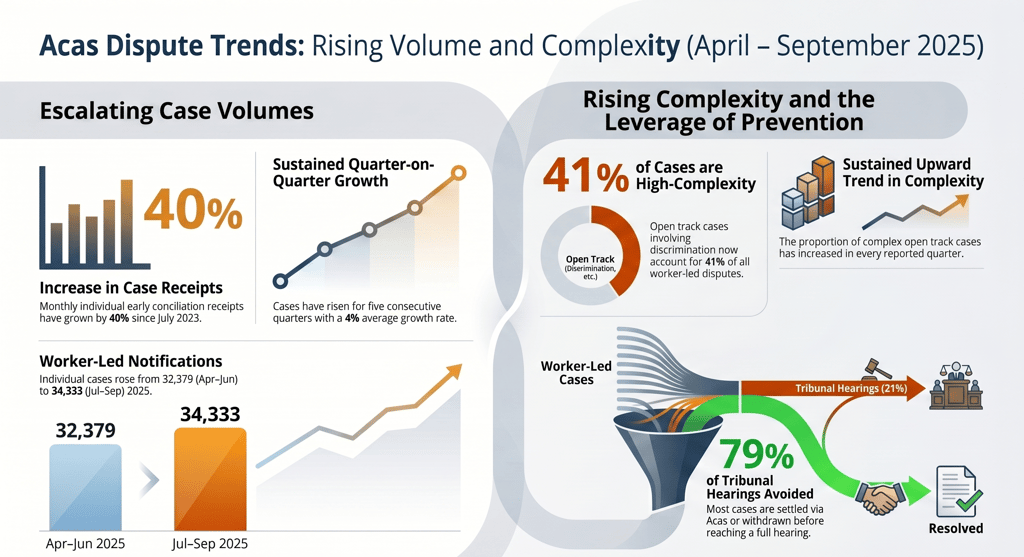
*ACAS statistical data for April to June 2025 recorded 32,379 worker-led individual early conciliation cases in a single quarter. By July to September 2025, that figure had risen to 34,333. Between July 2023 and September 2025, monthly individual early conciliation case receipts increased by 40%, with consistent quarter-on-quarter growth of 4%. The trend is not cyclical. It is directional.
Of particular significance is the composition of that caseload. Open track cases — the most legally complex, involving discrimination and disclosure jurisdictions — now account for 41% of all worker-led individual cases, a proportion that has increased in every successive quarter. These are not straightforward money claims. They are substantive disputes, many of which have their origin in a disciplinary or dismissal process that was poorly handled at the point it mattered most.
Seventy-nine per cent of employment tribunal cases in that period did not proceed to a full hearing. The majority were resolved through Acas conciliation or withdrawn — but only after notification had been made, costs incurred, and management time committed. Prevention, at the internal process stage, remains the point of greatest leverage.
The Room Is Where It Counts
The data reflects a workforce that is increasingly aware of its rights and increasingly willing to pursue them. For employees navigating a disciplinary or misconduct process, the procedural decisions made in the weeks before a hearing — what is challenged, what is documented, and how the case is positioned — determine what options remain available afterwards.
At Zhan Associates, we work at that stage: before the hearing, in the room, and through the appeal if required. Remember, what's said in the room matters.
Shakil Dixon | Specialist Workplace Defence Representative | Zhan Associates
If you are facing a disciplinary process or have been dismissed, visit www.zhanassociates.co.uk or contact us at support@zhanassociates.co.uk | 07550 030156
*Source: ACAS Early Conciliation and Employment Tribunal Data, April–June 2025 and July–September 2025 Statistical Bulletins.