The Employment Rights Act 2025
The Employment Rights Act 2025: A somewhat deep-dive into a significant Act. This is what workers have been waiting for – but the devil, as always, is in the detail. In a somewhat lengthy piece we look at the good, the bad - and the uncertain.
The Employment Rights Act 2025: The Biggest Shake-Up in Worker Protections in a Generation (And What It Actually Means for You)
From Green Paper to Law: A Brief History
The Employment Rights Act didn't materialize out of nowhere. Its roots trace back to Labour's opposition years, specifically the 2022 Green Paper "A New Deal for Working People" drafted under Jeremy Corbyn's leadership. That original vision was bold: repeal all anti-union legislation, ban zero-hours contracts outright, introduce a single employment status, and make unfair dismissal a day-one right with no qualifying period.
Then Keir Starmer took over in 2020 and moved Labour back to the center. The proposals were substantially watered down in consultation with business groups – the price of making the reforms palatable to employers and investors ahead of the 2024 general election. The Green Paper evolved into "Labour's Plan to Make Work Pay," published in June 2024, which became the blueprint for the Employment Rights Bill.
Labour won the 2024 election with employment rights as a central manifesto commitment. Business Secretary Jonathan Reynolds introduced the Bill to Parliament on 10 October 2024. It was ambitious from the start: 28 major employment reforms across unfair dismissal, zero-hours contracts, family rights, flexible working, sexual harassment, and trade union law.
The Bill faced fierce debate. The House of Commons passed it in March 2025 after 21 committee sittings and 264 amendments. The House of Lords proved more challenging – 11 committee sittings between April and June 2025 saw 646 amendments tabled, with substantial opposition from business-aligned peers.
The key battleground? Day-one unfair dismissal rights. The Lords refused to pass it. What followed was classic parliamentary "ping-pong" – the Bill shuttling between Commons and Lords until a compromise was reached in November 2025: a six-month qualifying period instead of day one, but with the compensation cap removed entirely as a concession to unions and workers.
On 18 December 2025, the Bill received Royal Assent and became the Employment Rights Act 2025. The first phase of "Make Work Pay" was law.
The Core Components: What's Actually Changing
The Act is sprawling – over 150 clauses covering nearly every aspect of employment law. Here are the headline reforms:
1. Unfair Dismissal: The Six-Month Compromise (And Uncapped Compensation)
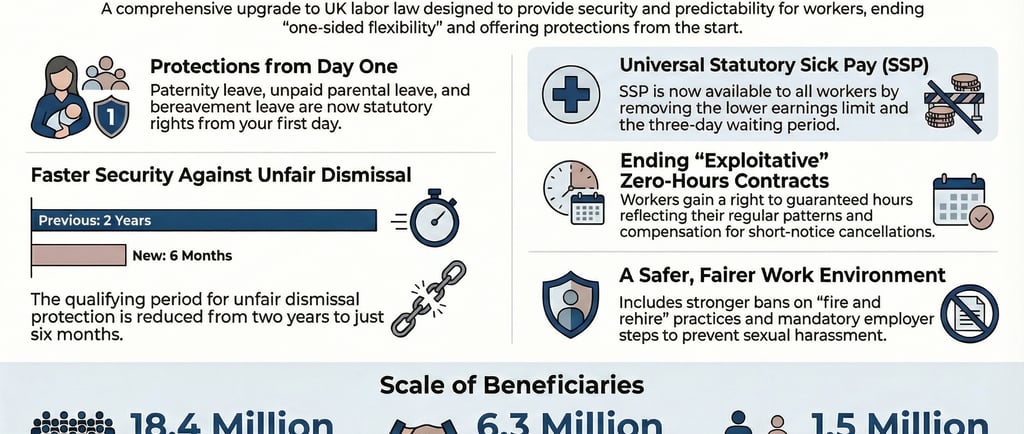
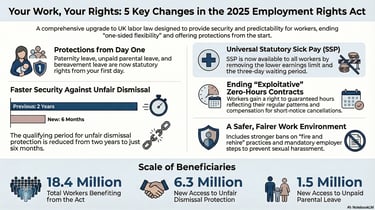
From 1 January 2027, the qualifying period to claim unfair dismissal drops from two years to six months. Anyone employed from July 2026 onwards will hit protection on New Year's Day 2027.
This is significant. Currently, around 30-40% of the workforce lacks unfair dismissal protection because they haven't been with their employer for two years. The six-month rule will extend protection to millions more workers.
But here's the bombshell that came at the 11th hour: the compensation cap is gone. Currently, unfair dismissal compensation is capped at the lower of 52 weeks' gross pay or £118,223. From January 2027, there's no cap. A senior executive earning £250,000 could theoretically receive an award of £250,000 or more if unfairly dismissed.
My take: This is a massive game-changer, particularly for high earners. It fundamentally shifts the risk calculation for employers. Settlement negotiations will get more expensive, and employers will be far more cautious about dismissing anyone earning six figures. The flip side? Tribunals are already drowning in cases. Removing the cap creates an incentive for high earners to litigate rather than settle, which will make the backlog worse.
2. Fire and Rehire: Restrictions (Not a Ban)
From October 2026, dismissing someone and rehiring them on worse terms becomes automatically unfair if the change involves "restricted variations" – core contractual terms like pay, hours, working time, holidays, or pensions.
There's an exception: businesses in "severe financial difficulty" with no alternative can still fire and rehire, but they must comply with the existing Code of Practice on dismissal and re-engagement.
Changes to other terms – like place of work or job duties – aren't automatically unfair, but tribunals will scrutinize the reason for the variation, the consultation process, and what was offered in return.
My take: This isn't the outright ban that unions wanted, but it significantly raises the bar. The "severe financial difficulty" exception is vague and will be litigated extensively. Expect employers to claim financial distress whenever they want to cut pay or hours, and expect tribunals to develop case law defining what "severe" actually means. Still, it's a substantial improvement over the current position where fire and rehire, while distasteful, is often lawful.
3. Zero-Hours Contracts: Guaranteed Hours and Shift Protections
This is complex and won't fully kick in until 2027, but here's the gist:
Workers on zero-hours or low-hours contracts who regularly work more than their guaranteed hours will have the right to be offered a contract reflecting those hours. The "reference period" is expected to be 12 weeks.
Employers must provide "reasonable notice" of shifts (likely to be defined as 48 hours or more based on amendments).
If shifts are cancelled or curtailed at short notice, workers get compensation.
These rights extend to agency workers, with anti-avoidance provisions to prevent employers gaming the system.
My take: The administrative burden on employers with large zero-hours workforces will be substantial. Calculating reference periods, tracking hours, issuing offers – this is going to require serious HR infrastructure. For workers, it's transformative. The UK has over a million people on zero-hours contracts. Many work predictable hours but without security. This reform addresses that directly. However, I predict employers will find creative ways to avoid triggering the 12-week threshold, like rotating workers or capping hours just below the trigger point.
4. Family and Bereavement Rights: Day-One Protections
From April 2026, parental leave and paternity leave become day-one rights. You don't need 26 weeks' service anymore – you can give notice from your first day.
A new statutory bereavement leave entitlement is introduced for pregnancy loss before 24 weeks (losses after 24 weeks already qualify for maternity/paternity leave). It's unclear whether this will be paid.
Dismissal protections for pregnant workers and those returning from maternity, adoption, or parental leave are strengthened. Dismissing a pregnant worker or someone in the six-month return-to-work period will be banned except in specific circumstances (to be defined in regulations).
My take: These are unambiguously positive. The UK's family leave provisions have lagged behind European neighbors for years. Making parental leave a day-one right recognizes that family circumstances don't wait for you to complete a qualifying period. The pregnancy dismissal ban is long overdue – pregnancy discrimination remains rampant, and the current protections are too weak.
5. Flexible Working: Tighter Rules on Refusals
Flexible working became a day-one right in April 2024, but the Act goes further. From 2027, employers can only refuse a flexible working request if there's a statutory ground for refusal AND it's reasonable to refuse.
Employers will also need to follow a prescribed process before rejecting requests, with consultation closing on the specifics in April 2026.
My take: The "reasonableness" test is key. Currently, employers can refuse on statutory grounds even if the refusal is arguably unreasonable. The new test shifts the burden. However, "reasonable" is subjective and will be litigated. Expect tribunals to develop a body of case law defining what refusals are reasonable in different contexts. This will be fact-specific and messy.
6. Sexual Harassment: Preventative Duty and Third-Party Liability
From April 2026, employers must take "all reasonable steps" to prevent sexual harassment – an upgrade from the current "reasonable steps" standard introduced in 2023.
Third-party harassment liability is reinstated. If a customer, client, or contractor harasses your employee, and the employer didn't take reasonable steps to prevent it, the employer can be held liable.
Sexual harassment becomes a "qualifying disclosure" under whistleblowing law, meaning workers who blow the whistle on sexual harassment are protected from detriment and dismissal.
My take: The shift from "reasonable" to "all reasonable" steps sounds minor but isn't. It requires proactive, comprehensive measures. Employers can't just have a policy and call it done – they need training, monitoring, response protocols, and demonstrable action. Third-party liability is particularly significant for hospitality, retail, and healthcare sectors where customer/client harassment is common. Employers will need to think seriously about how to protect staff from external harassers.
7. Trade Union Reforms: Repealing Anti-Union Laws
The Strikes (Minimum Service Levels) Act 2023 is repealed (this happened immediately on Royal Assent).
Most of the Trade Union Act 2016 is repealed from April 2026, including the requirement for 40% turnout in public sector strike ballots.
Union recognition processes are simplified. The notice period for industrial action drops to 10 days (from 14), and ballot mandates extend to 12 months (from six).
Employers must inform workers of their right to join a union as part of the written particulars of employment. Unions get strengthened rights of workplace access.
My take: This is the most significant pro-union legislation in decades. The repeal of minimum service levels and the loosening of ballot restrictions will make industrial action easier to organize and sustain. For workers, stronger unions mean better collective bargaining power. For employers – particularly in unionized sectors like transport, education, and healthcare – this means more strikes and more leverage for unions in negotiations. Whether you think that's good or bad depends on your politics, but it's undeniably a shift in power toward organized labor.
8. Statutory Sick Pay: Lower Earnings Limit Removed
From April 2026, the lower earnings limit for Statutory Sick Pay (SSP) is removed. Currently, you need to earn at least £123 per week to qualify. That restriction goes.
My take: This extends SSP to low-paid and part-time workers who've historically been excluded. It's a basic fairness measure. If you're sick, you shouldn't lose income just because you're on a low wage. The fiscal cost to the state will be minimal; the cost to employers will be manageable. This should have been done years ago.
9. Tribunal Time Limits: Three Months to Six Months
From October 2026, the time limit to bring most employment tribunal claims extends from three months to six months.
My take: I'm torn on this. On one hand, three months is brutally short, particularly if you're dealing with the trauma of dismissal, trying to find a new job, and navigating complex legal processes. Six months is more humane. On the other hand, the tribunal system is already in crisis with a 52,000-case backlog. Extending time limits means claims will be filed months later than they currently are, and the backlog will worsen. The government needs to massively increase tribunal capacity to handle this, and I don't see evidence that's happening.
10. The Fair Work Agency: Enforcement with Teeth
From April 2026, the Fair Work Agency comes into being, consolidating enforcement of minimum wage, holiday pay, statutory sick pay, and other labor standards.
The FWA can investigate proactively, issue penalties, demand six-year repayment of holiday pay violations, and publicly name offenders.
My take: See my previous blog on the FWA. This is potentially the most impactful long-term reform in the Act. Rights without enforcement are meaningless. The FWA provides the muscle to make these reforms stick.
What's Missing: The Compromises and Concessions
For all its ambition, the Act represents significant compromises from Labour's original vision:
Day-one unfair dismissal is gone. The original proposal would have protected all employees from day one, with a light-touch "initial period of employment" for probationary dismissals. Business lobbying killed it. Six months is better than two years, but it's not day one.
Single employment status is gone. The Green Paper proposed eliminating the distinction between "employee," "worker," and "self-employed" to create a single status with universal rights. It didn't make it into the Act. The complex, confusing patchwork of employment statuses remains.
Fire and rehire isn't banned. It's restricted to "core terms" with a financial distress exception. Unions wanted an outright ban.
Zero-hours contracts aren't banned. They're regulated, but they still exist. Workers get more protection, but the fundamental precarity remains for many.
Collective redundancy reforms are incremental. The protective award doubles from 90 to 180 days, and there's a new "whole organization" threshold, but the core framework is unchanged.
The Implementation Timeline: What Happens When
The Act doesn't come into force all at once. Here's the rollout:
18 December 2025 (Royal Assent): Repeal of Strikes (Minimum Service Levels) Act 2023 took effect immediately.
18 February 2026: Dismissal for industrial action becomes automatically unfair with no 12-week limit.
April 2026: Day-one rights for paternity and parental leave; SSP lower earnings limit removed; sexual harassment preventative duty; trade union reforms; FWA established; whistleblowing protections for sexual harassment; menopause and gender pay gap action plans (voluntary initially); simplified trade union recognition.
October 2026: Fire and rehire restrictions; extended tribunal time limits (six months); third-party harassment liability; strengthened trade union access rights; protection against detriment for industrial action; tips and gratuities provisions.
January 2027: Six-month unfair dismissal qualifying period; uncapped compensation; fire and rehire restrictions take effect.
2027 (dates TBC): Zero-hours contract reforms (guaranteed hours, shift notice, cancellation pay); strengthened pregnancy dismissal protections; bereavement leave; flexible working reforms; collective redundancy threshold changes; further sexual harassment measures.
Many of these dates depend on secondary legislation and ongoing consultations, which means uncertainty and delay.
My Observations: The Good, the Bad, and the Uncertain
The Good
This is the most worker-friendly legislation in a generation. The shift from two years to six months for unfair dismissal is huge. Zero-hours protections, family leave improvements, sexual harassment duties, and trade union reforms all represent meaningful progress.
The Fair Work Agency has the potential to transform enforcement. For too long, employment rights have been theoretical for workers who couldn't afford to enforce them. The FWA changes that.
Removing the compensation cap is a bold move that will force employers to take unfair dismissal seriously. High earners will have real leverage in settlement negotiations.
The Bad
The Act is complicated, with implementation spread over two years and dozens of consultations still pending. Employers face massive uncertainty about what's coming when.
The tribunal system can't handle the current caseload, and the Act will substantially increase claims. Without significant investment in tribunal capacity, the system will collapse under the weight.
The compromises – particularly the abandonment of day-one unfair dismissal and single employment status – represent missed opportunities to fundamentally restructure employment law for the modern economy.
The "reference period" calculations for zero-hours workers will create administrative nightmares and litigation over whether workers qualify for guaranteed hours offers.
The Uncertain
How will tribunals interpret "severe financial difficulty" for the fire and rehire exception? What counts as "reasonable" in flexible working refusals? When exactly does a zero-hours worker trigger the 12-week reference period?
These questions will only be answered through years of case law. Workers and employers are operating in uncertainty.
Will the FWA be properly resourced? Government agencies are chronically underfunded. If the FWA launches with inadequate staff and budget, it'll be toothless despite its theoretical powers.
How will employers respond? Some will comply in good faith. Others will find creative ways to avoid the new rules – rotating zero-hours workers, structuring dismissals to fall outside six months, claiming financial distress when it's not warranted.
## What This Means for Workers Facing Disciplinary Action
If you're reading this because you're in a workplace dispute, here's what the Act means practically:
If you're dismissed after 1 January 2027 and you have six months' service, you can claim unfair dismissal. This protection doesn't exist for most people right now.
If your employer tries to fire and rehire you on worse pay or hours, it'll be automatically unfair from October 2026 (unless they can prove severe financial distress).
If you're on a zero-hours contract and regularly work predictable hours, you'll have the right to a guaranteed hours contract from sometime in 2027.
If you've been sexually harassed and want to speak out, NDAs can't silence you from 2027.
If you're pregnant or returning from maternity leave, your dismissal protections are being strengthened in 2027.
If you're in a union or want to join one, your employer must inform you of that right from April 2026.
But here's the reality check: most of these protections haven't kicked in yet. If you're facing a disciplinary hearing in February 2026, the six-month rule doesn't help you. If you need protection now, you're still operating under the old rules.
The Bigger Picture: Is This Enough?
The Employment Rights Act 2025 is ambitious, comprehensive, and long overdue. It represents a fundamental rebalancing of power in the workplace after decades of erosion of worker protections.
But is it enough? That depends on your baseline.
If you compare it to the Thatcher and Major years when unions were crushed and workers' rights were systematically weakened, this is transformative.
If you compare it to European neighbors with stronger collective bargaining, sector-wide agreements, and works councils, it's incremental.
If you compare it to Labour's original Green Paper with day-one rights and single employment status, it's a compromise.
My view? It's significant progress that will meaningfully improve conditions for millions of workers. The six-month unfair dismissal rule alone will protect people who are currently vulnerable. Zero-hours reforms will reduce precarity. Trade union strengthening will shift bargaining power.
But it's not revolutionary. The fundamental structure of UK employment law – with its complex employment statuses, individual rather than collective focus, and reliance on tribunal litigation – remains intact.
Real transformation would require a shift to sectoral collective bargaining, works councils, and simplified employment status. Those reforms aren't in this Act.
Final Thoughts
The Employment Rights Act 2025 is a big deal. It's the biggest upgrade to worker protections since the 1990s, and it will reshape UK employment law for a generation.
For workers, it offers real, tangible improvements in job security, pay protection, and the ability to challenge unfair treatment.
For employers, it creates compliance headaches, increased costs, and genuine legal risk for getting dismissals wrong.
For all of us, it represents a statement about the kind of workplace culture we want: one where workers have dignity, security, and voice, not just at the employer's discretion but as a matter of legal right.
Implementation will be messy. There will be litigation, confusion, and unintended consequences. But the direction of travel is clear: towards stronger protections, better enforcement, and a rebalancing of workplace power.
Whether that's enough depends on who you ask. But it's undeniably progress.
And after decades of stagnation, progress is something worth noting.
About this article: This blog reflects the views of Zhan Associates as workplace advocates. We are not solicitors and this is not legal advice. For specific legal guidance on how the Employment Rights Act affects your situation, consult a qualified employment solicitor. If you're facing a disciplinary hearing and need immediate advocacy support under current law, contact us.